Niger Delta Divided As Ex-Agitators Demand Decentralisation Of Pipeline Contracts, Raising Questions Over Tinubu’s 2027 Support
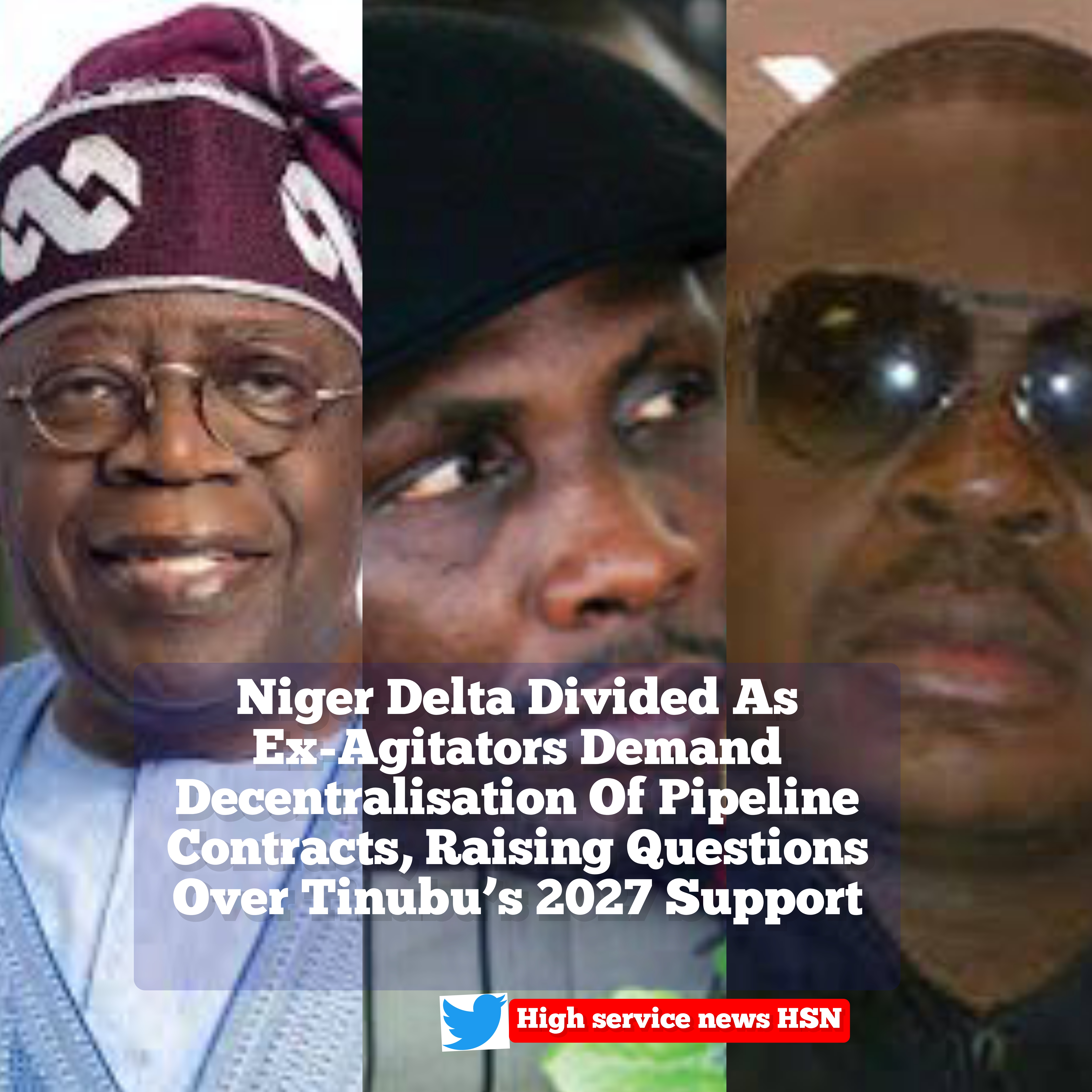
.......From The Controversy Over Tompolo’s ₦2.1 Trillion Pipeline Surveillance Arrangement To Otuaro’s ₦115 Billion Amnesty Budget, Former Agitators Demand Fairness As Regional Tensions Mount
Divisions among former Niger Delta agitators are emerging as a significant issue in the region’s political landscape ahead of the 2027 general elections, with renewed demands for the decentralisation of pipeline surveillance contracts raising questions about the distribution of government opportunities, regional representation and the ability of influential former militant leaders to work together.
At the centre of the controversy is the pipeline surveillance arrangement associated with Government Ekpemupolo, popularly known as Tompolo, through Tantita Security Services Nigeria Limited, alongside complaints from other former agitators who believe the current arrangement concentrates too much control in the hands of one individual while leaving other influential stakeholders and their communities on the sidelines.
The controversy extends beyond pipeline surveillance. Questions have also been raised about the Presidential Amnesty Programme under its current administrator, Chief Dennis Otuaro, particularly following the reported increase in the programme's budget from ₦65 billion to ₦115 billion without a corresponding increase in the monthly stipends received by beneficiaries, which remain at ₦65,000.
Together, these issues have intensified a broader debate about fairness, economic opportunities, accountability and political inclusion in the Niger Delta.
With the 2027 elections approaching, the central question is whether the Federal Government's handling of the region's security contracts and amnesty programme can maintain the cooperation of former agitators and other influential stakeholders or deepen existing divisions.
EX-AGITATORS HAVE ALREADY RAISED THE ALARM
The demand for decentralisation is not new. On March 26, 2026, former Niger Delta agitators and members of the Niger Delta Stakeholders Forum (NDSF) publicly called on President Bola Tinubu's administration to decentralise pipeline surveillance contracts and distribute opportunities across the nine states of the Niger Delta.
Speaking at the palace of the Amanyanabo of Okochiri Kingdom, King Ateke Michael Tom, former militant leader General Shoot-at-Sight criticised the centralised arrangement, describing it as unfair to other leaders who had participated in the struggle for the region.
He argued that pipeline security had previously been managed on a state-by-state basis under former President Goodluck Jonathan and claimed that oil production had not improved as expected under the current arrangement.
“We were doing this job state by state. Since they gave this job to only one person, oil production has not increased again,” Shoot-at-Sight said.
His remarks reflected a grievance that goes beyond the question of who holds a contract: whether the financial benefits, employment opportunities and responsibilities associated with protecting Nigeria's oil infrastructure should be concentrated in one major contractor or shared among a wider network of qualified regional stakeholders.
General Boy-Loaf also called on Tinubu to decentralise the arrangement, arguing that cooperation among former agitators and other stakeholders was important to achieving the administration's objectives ahead of 2027.
“If the President really wants to achieve what he wants in 2027, he has to show love, because only one person cannot deliver,” he said.
NDSF Secretary-General Theophilus Tari Alaye similarly argued that decentralisation would create employment opportunities for young people, improve regional participation and support peace and economic development.
The leaders called for immediate action rather than postponing the issue until after the elections.
Their statements demonstrate that dissatisfaction with the current arrangement was being expressed publicly months before the final stretch of the 2027 election campaign.
TOMPOLO'S DOMINANT POSITION AND THE QUESTION OF INCLUSION
Tompolo has become one of the most prominent figures associated with private pipeline surveillance in the Niger Delta through Tantita Security Services.
The scale of the company's reported arrangement has generated considerable public discussion, with activist and journalist Fejiro Oliver repeatedly attributing an annual value of approximately ₦2.1 trillion to the Tantita arrangement.
However, the precise contractual value, amounts actually disbursed, operational expenditure and net profit should be established through the relevant government contracts, payment records and audited accounts. A reported contract value should not automatically be interpreted as personal income or profit.
Nevertheless, the arrangement raises an important policy question: should a contract of such strategic and financial significance remain concentrated within one major contractor, or should the government create a transparent framework that allows other qualified regional operators to participate?
For some former agitators, decentralisation represents an opportunity to address what they perceive as exclusion from an industry that has become central to oil security in the Niger Delta.
Their argument is that a wider distribution of contracts could create additional jobs, expand local participation and reduce the perception that access to government-funded opportunities depends excessively on proximity to a particular influential figure.
Tompolo's position as a prominent contractor does not, by itself, establish wrongdoing. Nor does the existence of competing demands prove that all dissatisfied former agitators share the same position.
However, the disagreement over contract distribution has exposed a wider question about how the government balances operational efficiency, accountability, security requirements and equitable participation.
The Federal Government must explain the criteria governing the awards, the performance standards applied to contractors and whether qualified companies have a fair opportunity to compete for clearly defined portions of the work.
A REGION DIVIDED WHILE ITS OIL WEALTH REMAINS CENTRAL TO NIGERIA
The political significance of the controversy lies in the divisions it has exposed among former agitators and regional stakeholders.
The Niger Delta is not a single political bloc. Its former militant leaders, traditional institutions, community organisations, political parties and civil society groups have different interests, relationships and expectations of government.
Some stakeholders may prioritise the continuation of existing arrangements, while others demand broader participation, greater transparency or alternative approaches to managing the region's oil infrastructure.
The March 26 intervention by Shoot-at-Sight, Boy-Loaf and the NDSF leadership illustrates that at least some prominent former agitators want the Federal Government to reconsider the centralised structure.
The disagreement also raises questions about the extent to which influential regional figures can coordinate around common demands despite competing interests.
If the different groups cannot agree on a framework for sharing responsibilities and opportunities, the government may face a more fragmented landscape when negotiating with regional stakeholders.
Conversely, a transparent decentralisation policy could give competing interests a common framework within which they can negotiate participation without turning every disagreement into a political confrontation.
The fundamental issue is not whether every former militant leader should receive a contract. It is whether the award of public contracts follows clear rules, delivers measurable results and provides qualified businesses and affected communities with a fair opportunity to participate.
OTUARO, TOMPOLO AND THE AMNESTY PROGRAMME CONTROVERSY
The debate over pipeline surveillance becomes more complicated when examined alongside the Presidential Amnesty Programme.
Chief Dennis Otuaro, who comes from Gbaramatu Kingdom, the same kingdom associated with Tompolo, heads the programme responsible for supporting beneficiaries of the federal government's post-amnesty initiative.
Their shared geographical and traditional background does not establish that they are acting together improperly. Nevertheless, the concentration of influence surrounding major security contracts and the administration of the amnesty programme has prompted questions about regional representation, institutional independence and the distribution of benefits.
For beneficiaries who believe their welfare has not improved sufficiently, the central issue is whether the programme is delivering tangible results commensurate with its funding.
The programme's budget reportedly increased from ₦65 billion to ₦115 billion, a rise of ₦50 billion, representing approximately 76.9 per cent.
Yet beneficiaries' monthly stipends remain ₦65,000, according to the figures cited in the ongoing debate.
That disparity has become a source of frustration for stakeholders who argue that an expanded budget should prompt a public explanation of how the additional funding is being allocated and what improvements beneficiaries should expect.
A larger budget does not automatically mean that all beneficiaries' stipends must rise by the same proportion. The programme may have other expenditure obligations, including training, education, reintegration and empowerment initiatives.
However, those obligations make transparency more important, not less.
The administrator and relevant government authorities should explain the allocation of the ₦115 billion budget, identify the amounts assigned to beneficiary welfare and other programme activities, and provide verifiable information about the outcomes being achieved.
If beneficiaries are expected to accept that the programme has greater financial resources but no corresponding increase in their monthly allowance, they deserve a clear explanation of the policy and its implementation.
₦115 BILLION BUDGET, ₦65,000 STIPEND: WHAT HAS CHANGED FOR BENEFICIARIES?
For former agitators and their families, the stipend debate is not simply an argument about figures on a government budget.
It concerns purchasing power, household expenses, education, healthcare and the practical challenges of reintegration into civilian life.
Beneficiaries who have remained on ₦65,000 monthly stipends may reasonably ask what the increase in the programme's overall budget means for their daily lives.
They may also ask whether the programme has expanded its training opportunities, settled outstanding allowances, improved vocational support or created sustainable employment opportunities.
These are questions that can be answered through financial disclosures and performance reports.
The government should publish a breakdown showing how the programme's expenditure has changed, how much is allocated to different categories of beneficiaries, what obligations remain outstanding and which reintegration initiatives have produced measurable results.
It should also explain whether a review of the stipend is under consideration and, if not, why the existing rate remains appropriate.
The important distinction is that the ₦115 billion budget is the programme's overall allocation, not necessarily the amount available for monthly stipends.
Nevertheless, the absence of a clear public explanation of how increased funding translates into benefits risks deepening mistrust among beneficiaries.
CAN TINUBU AFFORD TO IGNORE THE POLITICAL IMPLICATIONS?
The demands for decentralisation have acquired a political dimension because some of the former agitators making them have explicitly connected the issue to the 2027 elections.
Boy-Loaf's March 26 statement was direct: he argued that the President needed to demonstrate inclusion and that one individual could not deliver the support of every stakeholder.
That statement should not be interpreted as proof that the former agitators have collectively decided to oppose Tinubu. Nor does it establish that decentralisation alone would determine their political choices.
It does, however, demonstrate that the distribution of pipeline surveillance opportunities has entered the political conversation surrounding the next general election.
For any administration seeking cooperation from a region with a history of oil-related conflict, security challenges and demands for greater resource benefits, the management of relationships with influential stakeholders can have political consequences.
If groups feel excluded, they may become less willing to cooperate with the administration's initiatives or may demand changes in government policy before offering their support.
If their concerns are addressed through a credible and transparent process, the government may create more room for cooperation across competing interests.
The political outcome remains uncertain.
Former agitators are not a unified electoral organisation, and their statements cannot establish how ordinary voters across Bayelsa, Rivers, Delta, Akwa Ibom, Cross River, Edo, Imo, Abia and Ondo will vote in 2027.
Nevertheless, the dispute presents Tinubu's administration with a governance challenge: how to maintain effective oil infrastructure protection while addressing legitimate concerns about transparency, opportunity and regional inclusion.
THE CORRUPTION QUESTION: ALLEGATIONS MUST BE TESTED WITH EVIDENCE
The concentration of a major contract within one principal contractor has also generated broader allegations and suspicions about corruption, financial accountability and the distribution of benefits.
However, the structure of a contract alone does not establish that corruption has occurred.
A credible assessment requires evidence concerning procurement procedures, contract terms, payments, subcontracting, beneficial ownership, operational expenditure and the actual performance of the work.
The government should disclose the contractual framework to the extent permitted by law, explain how contractors are selected and provide independent assessments of whether they are meeting their obligations.
Where there are specific allegations of financial misconduct, the relevant authorities should investigate them and publish their findings through appropriate procedures.
Tantita and other companies associated with pipeline surveillance should also have an opportunity to respond to specific, substantiated allegations.
The same standards should apply to every contractor, regardless of political connections, ethnic identity, traditional standing or history of involvement in the Niger Delta struggle.
Decentralisation, if adopted, must not simply replace one concentration of power with multiple opaque arrangements. Any expanded framework should include transparent selection criteria, measurable performance requirements, independent audits and safeguards against political patronage.
Otherwise, the region could end up with more contractors without necessarily achieving better accountability or improved welfare for its people.
WHAT DECENTRALISATION COULD MEAN FOR THE NIGER DELTA
If implemented through a transparent framework, decentralisation could create opportunities for qualified companies and security operators across the region to compete for defined responsibilities.
It could also expand employment opportunities, strengthen community engagement and give more stakeholders a direct interest in protecting oil infrastructure.
However, decentralisation would require careful planning.
The government would need to determine how responsibilities should be divided, how different operators would coordinate, how performance would be monitored and how disputes would be resolved.
It would also need to ensure that the arrangement does not create overlapping responsibilities, weaken operational coordination or increase the cost of protecting pipelines.
The question, therefore, is not simply whether the contract should be divided. It is how the government can design a system that combines operational effectiveness with fair competition, accountability and regional participation.
The former agitators demanding decentralisation should be prepared to explain how their proposed framework would work, while the government should publicly justify the existing arrangement and demonstrate whether alternative models have been considered.
A transparent process would allow the debate to move beyond personal rivalries and towards measurable outcomes for the region.
THE NIGER DELTA'S PEOPLE MUST NOT BE LEFT OUT OF THE CONVERSATION
Beyond the competing interests of former militant leaders and contractors, the region's ordinary residents have a direct stake in how oil security contracts and the amnesty programme are managed.
Communities hosting pipelines continue to face questions about employment, environmental protection, infrastructure, access to economic opportunities and the long-term consequences of oil production.
The people who live around the infrastructure should not be treated merely as spectators to the billions of naira spent protecting it.
They deserve to know how much employment is being created locally, what environmental safeguards are being enforced, how complaints are handled and whether public expenditure is producing measurable improvements.
The same principle applies to the Presidential Amnesty Programme. Beneficiaries and their communities deserve transparent information about funding, training, education, empowerment and reintegration.
If the programme's budget has increased significantly, the government should demonstrate how that investment contributes to its stated objectives.
If pipeline surveillance spending has reached the scale suggested by publicly circulated figures, the government should explain the contractual obligations and measurable security outcomes associated with that expenditure.
The Niger Delta's long-term stability cannot depend exclusively on relationships among powerful individuals. It requires institutions that residents can question, financial arrangements that can be scrutinised and policies that deliver verifiable benefits.
2027 AND THE BIGGER QUESTION OF TRUST
The March 26 demands for decentralisation, the dispute over the distribution of pipeline surveillance opportunities and the continuing questions surrounding the Amnesty Programme point to a wider issue of trust between the Federal Government and different groups in the Niger Delta.
For Tinubu's administration, the challenge is to demonstrate that regional security arrangements and reintegration programmes operate according to transparent, defensible rules.
For former agitators, the challenge is to articulate their demands in a way that prioritises public interest, employment, security and accountability rather than merely competing for access to government contracts.
For the Presidential Amnesty Programme, the challenge is to show how its increased budget translates into measurable benefits for beneficiaries.
And for the companies entrusted with protecting oil infrastructure, the challenge is to demonstrate that the resources committed to their operations produce results that justify the expenditure.
None of these questions can be resolved simply by assuming that all former agitators will support or oppose a particular presidential candidate.
The Niger Delta's political landscape is diverse, and the positions of its stakeholders may change as policies, alliances and local interests evolve.
What is already clear is that the dispute over pipeline surveillance has become part of the wider conversation about representation, public spending and political relationships ahead of 2027.
CONCLUSION: THE GOVERNMENT MUST ANSWER THE QUESTIONS
The demand made by former Niger Delta agitators and the NDSF on March 26, 2026, has placed an important issue before the Federal Government: whether pipeline surveillance contracts should remain structured around a dominant contractor or be reorganised to permit wider participation by qualified operators.
The controversy has also drawn attention to the Presidential Amnesty Programme, where the reported increase in the budget from ₦65 billion to ₦115 billion has not been accompanied by an increase in the ₦65,000 monthly stipend cited by beneficiaries and stakeholders.
These issues raise legitimate questions about transparency, distribution, employment, reintegration and the management of relationships across the Niger Delta.
But the solution must go beyond political calculations.
The Federal Government should explain the basis of its pipeline surveillance arrangements, publish appropriate financial and performance information, examine credible proposals for decentralisation and provide a clear account of how the Amnesty Programme's expanded budget is being used.
It should also ensure that any changes protect oil infrastructure effectively, promote fair competition and prevent the multiplication of opaque contracts.
Ultimately, the question is not whether one individual or another should control the Niger Delta's oil-security industry.
The question is whether the system delivers effective security, transparent spending, fair opportunities and measurable benefits to the people of the region.
As the 2027 elections approach, the way these questions are addressed will form part of the wider debate over governance and political trust in the Niger Delta.









0 Comment(s)