Tinubu And The Jonathan Mock Coffin Saga: When The Opposition Could Mock A President, Why Can't Nigerians Say Tinubu Must Go?
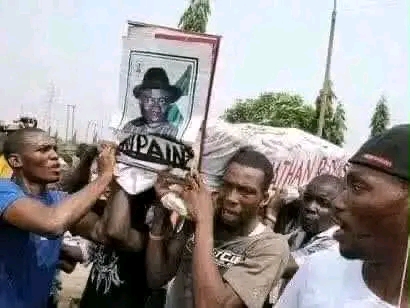
...From Mock Coffins Against Jonathan To Arrests Over Tinubu Must Go: Isaac Fayose Reignites Debate Over Political Hypocrisy, Freedom Of Expression And The Price Of Dissent
A fresh political controversy has erupted over what critics describe as a glaring contradiction between the political tactics used against former President Goodluck Jonathan and the reported restrictions facing Nigerians who oppose President Bola Ahmed Tinubu's administration.
The controversy has gained renewed attention following a message attributed to Prince Isaac Fayose, who recalled the infamous mock-coffin protests against Jonathan during the January 2012 Occupy Nigeria demonstrations in Lagos and questioned why Nigerians expressing opposition to Tinubu should face intimidation or arrest.
The debate has placed Tinubu, who was a prominent opposition politician during the Jonathan administration, at the centre of a historical comparison that raises questions about political consistency, freedom of expression and the treatment of dissent under successive governments.
The central question now confronting Nigeria's political class is straightforward: If Nigerians could publicly protest against Jonathan, carry mock coffins bearing his image and demand political change, why should peaceful opposition to Tinubu be treated differently?
TINUBU'S ROLE IN THE OPPOSITION THAT CHALLENGED JONATHAN
In January 2012, Nigeria witnessed one of its most significant nationwide protest movements after Jonathan's administration announced the removal of the petrol subsidy, triggering a sharp increase in fuel prices.
The protests, popularly known as Occupy Nigeria, spread across several cities, including Lagos, Abuja, Kano and Ibadan.
At Gani Fawehinmi Park in Ojota, Lagos, demonstrators employed dramatic protest tactics, including the display of a mock coffin bearing Jonathan's image and inscriptions expressing opposition to his administration.
The demonstrations brought together labour unions, civil society organisations, opposition politicians, activists and ordinary Nigerians angered by the economic consequences of the subsidy removal.
Tinubu, then a prominent opposition leader and a leading figure in the Action Congress of Nigeria, was among the political figures associated with the opposition to Jonathan's subsidy policy.
His political camp challenged the government's decision, while protests and public criticism placed enormous pressure on the Jonathan administration.
Contemporary commentary has also highlighted Tinubu's public opposition to the subsidy policy. However, the broader claim that he personally organised or directed the carrying of the mock coffin in Ojota should not be treated as established fact without specific supporting evidence.
Nevertheless, the historical episode remains a powerful reference point in today's debate over the rights of Nigerians to criticise their leaders.
For critics of the current administration, the irony is difficult to ignore: political opposition once employed provocative methods against a sitting president, yet Nigerians now face controversy over wearing T-shirts bearing the words Tinubu Must Go.
'WHY CAN'T NIGERIANS CHANT TINUBU MUST GO?' — FAYOSE'S MESSAGE
In a message circulated online, Prince Isaac Fayose drew a comparison between the treatment of Jonathan during the 2012 protests and the controversy surrounding opposition to Tinubu.
The message recalled how demonstrators publicly displayed a mock coffin against Jonathan while he remained in office and questioned why similar political expressions directed at the current president should provoke resistance.
Fayose's message also referred to Jonathan's mother, who was reportedly watching events unfold from her home in Otuoke, Bayelsa State, while her son faced intense public criticism.
The post argued that political leaders who benefited from aggressive opposition campaigns should understand that the same democratic freedoms must remain available to their critics.
It further criticised reported attempts to prevent political gatherings and the arrest of individuals associated with the Tinubu Must Go message.
The message carried a warning that political anger cannot simply be eliminated through intimidation, adding that attempts to suppress public criticism could intensify resentment rather than resolve it.
Its central argument was that political power does not erase history and that the methods used against one administration can become a reference point when another administration faces public discontent.
Fayose's remarks have consequently reignited discussions about whether Nigeria's political class consistently defends freedom of expression or embraces it only when doing so serves its interests.
FIVE MEN ARRESTED OVER 'TINUBU MUST GO' T-SHIRTS
The debate has acquired fresh significance following the arrest and prosecution of five men in Maiduguri, Borno State, over a controversy involving T-shirts bearing the inscription Tinubu Must Go.
According to reports published by PREMIUM TIMES on September 30 and October 1, 2026, the men were charged with offences including criminal conspiracy, inciting disturbance, disturbance of public peace and thuggery.
The police subsequently said the suspects were also found with substances and other items that raised additional allegations.
The Borno State Police Command maintained that the prosecution was not based solely on the political message printed on the T-shirts.
However, the arrests triggered criticism from opposition figures and rights advocates, who questioned whether the authorities were using public-order laws to suppress political expression.
The African Democratic Congress also disputed the police account of the circumstances surrounding the arrests, presenting a different version of events.
The competing accounts have made the case a focal point in the wider argument over the limits of political expression and the responsibilities of law-enforcement agencies in a democracy.
The allegations against the defendants remain matters for the judicial process to determine.
The critical distinction is that wearing a political message is not, by itself, proof that a person has committed a criminal offence. Any prosecution must be justified by evidence of the alleged unlawful conduct.
KANO MEETING CONTROVERSY ADDS TO THE DEBATE
The controversy extended to Kano State on October 11, 2026, when members of the Tinubu Must Go movement reportedly encountered a police blockade while attempting to access a venue for a planned meeting.
According to a report published by Global Upfront Newspapers on October 12, the incident prompted protests from organisers and criticism from rights advocates.
The reported obstruction has raised further questions about whether political groups opposed to the president can assemble peacefully and discuss their political demands without unnecessary interference.
Authorities have responsibilities to maintain public order and respond to credible security threats. Those responsibilities, however, must be exercised consistently with constitutional protections for peaceful assembly, association and expression.
The circumstances surrounding each incident matter. A peaceful political gathering should not automatically be equated with a threat to public security, just as allegations of unlawful conduct must be assessed on their individual evidence.
For critics of the administration, the recent incidents evoke the memory of the 2012 protests and the political freedoms exercised by those who opposed Jonathan.
FROM 'JONATHAN IS DEAD' TO 'TINUBU MUST GO'
One of the most striking elements of the controversy is the contrast between the language of political protest in 2012 and the slogans now directed at Tinubu.
During the Jonathan era, protesters used mock coffins, provocative inscriptions and dramatic public demonstrations to communicate their opposition to government policies.
Today, the phrase Tinubu Must Go has become a rallying message for some Nigerians who want the president's administration to leave office.
The two campaigns emerged in different political circumstances and should not be treated as identical in every respect. The Jonathan protests were closely associated with opposition to petrol subsidy removal, while the current campaign reflects broader political grievances and demands for a change in leadership.
Nevertheless, both episodes raise a fundamental question about democratic consistency.
Can political actors defend confrontational protest when they are in opposition but demand restraint when similar tactics are directed at them?
Can citizens who publicly challenge a government be protected under the same principles regardless of which party controls the presidency?
And should the right to criticise a president depend on whether the criticism comes from a political ally or an opponent?
These are questions that Nigeria's political leaders, security agencies and civil society organisations must confront honestly.
FAYOSE'S MESSAGE: 'WHAT GOES AROUND COMES AROUND'
In his post, Fayose emphasised the principle that political actions have consequences and that leaders cannot permanently escape the historical record of their own political struggles.
Other reactions accompanying the post expressed support for continued public criticism of the government and argued that political power should not be used to silence people demanding accountability.
Some commentators described the controversy as an example of political double standards, while others used the discussion to call for a new political direction.
One response praised Fayose for speaking across ethnic divisions, arguing that Nigerians should defend citizens' rights regardless of ethnicity or political affiliation.
Another reaction maintained that documented historical events should continue to be discussed because political leaders cannot simply erase their previous positions when circumstances change.
The reactions reflect a broader frustration among sections of the public over economic hardship, political accountability and the perceived inconsistency of political actors.
However, these comments represent the views of individual commentators and should not be interpreted as evidence that all Nigerians share the same political position.
A WARNING TO NIGERIA'S POLITICAL CLASS
The controversy surrounding the Jonathan mock-coffin protests and the Tinubu Must Go campaign offers a broader lesson about democratic governance.
Political freedom cannot be defended selectively.
If opposition politicians have the right to criticise a government, organise demonstrations and use forceful slogans, those principles must also apply when they occupy positions of power and become the targets of public criticism.
Equally, the exercise of those freedoms does not exempt protesters from laws that legitimately protect public safety. Any restrictions must be lawful, necessary and proportionate rather than a convenient means of suppressing disagreement.
The government, opposition parties and security agencies must therefore demonstrate that the rules governing political expression apply equally to everyone.
The controversy also underscores the importance of historical accountability. Political leaders who once demanded freedom to oppose a government should expect Nigerians to scrutinise how they treat dissent when the political tables turn.
For Tinubu and his administration, the growing debate presents an opportunity to clarify the government's position on peaceful political expression and demonstrate that criticism of the president is not, in itself, grounds for intimidation.
THE QUESTIONS NIGERIANS DESERVE ANSWERS TO
As the debate intensifies, several questions demand clear answers:
1. What principles should determine whether a political protest is lawful or unlawful, regardless of the president being targeted?
2. Are security agencies applying the same standards to supporters of the government and its opponents?
3. What evidence supports the allegations against the men arrested in Maiduguri, beyond the political inscriptions on their T-shirts?
4. Why should Nigerians who peacefully demand a change in government face restrictions that cannot be justified by specific, lawful security concerns?
5. Will Nigeria's political leaders defend the right to dissent consistently, including when the criticism becomes uncomfortable or personally directed at them?
These questions deserve evidence-based answers rather than political insults, ethnic arguments or attempts to rewrite history.
CONCLUSION: HISTORY REMAINS A POWERFUL POLITICAL WITNESS
The mock-coffin protests against Jonathan in 2012 remain a vivid reminder of how far political opposition in Nigeria can go when citizens are angry with a government.
The present controversy surrounding Tinubu Must Go T-shirts and political gatherings has revived that memory, placing the conduct of today's political leaders under renewed scrutiny.
The essential issue is not whether a particular president deserves political support or opposition. It is whether Nigerians can peacefully express their political preferences without facing unjustified restrictions.
Democracy cannot function properly if freedom of expression is celebrated when it benefits one political camp and condemned when it benefits another.
As the country approaches another electoral cycle, the treatment of peaceful dissent will remain an important test of the commitment of political leaders and security agencies to constitutional democracy.
The question confronting Nigeria is simple: Will the freedom to oppose a president remain a democratic right, or become a privilege available only to those whose political interests align with the government?





0 Comment(s)