Court Dismissed ₦1bn Defamation Suit — Journalist Freed, Then Re-Arrested Amid Allegations of Intimidation by Dennis Otuaro, PAP Administrator
- by Elaye, Bayelsa, HSN
- about 6 months ago
- 708 views
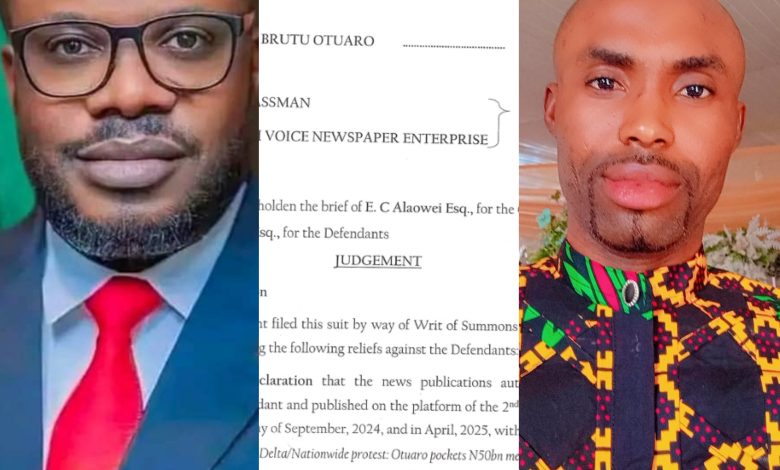
...Passman And His Wife Qppealed To Nigerians, Portraying The Post‑Judgment Events As an Attempt To Intimidate The Press And To Circumvent The Court’s Decision.
In a sharply contested legal battle that has gripped Bayelsa’s media and political circles, the High Court of Bayelsa State in Yenagoa on Monday dismissed a ₦1 billion defamation suit brought by Chief Dennis Brutu Otuaro, Administrator of the Presidential Amnesty Programme (PAP), against journalist Akpos Passman and Tarakirivoice Newspaper Enterprise.
Delivering judgment in Suit No. BHYCYHC/CV/182/2025, Justice Charlie Ebiyon Duke found that, although the court had jurisdiction and the media outlet was properly named as a defendant, the claimant failed to meet the strict evidentiary threshold required in defamation actions. Chief Otuaro had accused the defendants of publishing two online articles and circulating a WhatsApp voice note in September 2024 and April 2025 that allegedly imputed financial impropriety in his management of the Amnesty Programme. He sought declarations, a perpetual injunction, national apologies, and ₦1 billion in damages.
At trial, the claimant produced two witnesses and tendered three exhibits — including online printouts and a flash drive — while the defence called one witness and denied authorship, arguing the platform hosted multiple contributors and did not originate the contested pieces. In a careful analysis of defamation law, Justice Duke reiterated the requisite elements a claimant must prove: publication, reference to the claimant, defamatory meaning, communication to a third party, falsity, and absence of lawful justification.
The court found that the publications did reference Chief Otuaro and were accessible on the second defendant’s platform, but concluded the claimant did not prove the falsity of the contested statements. The judge described the evidence relating to financial transactions as largely hearsay, noted the claimant did not personally take the witness stand to robustly rebut the allegations under cross‑examination, and rejected one of the exhibits as inadmissible. On that basis the suit was dismissed in its entirety.
What should have been a clear legal victory for press freedom took an alarming turn after the ruling. Akpos Passman told reporters he was accosted by police officers while standing along the Sani Abacha Expressway in Yenagoa shortly after the judgment. According to Passman, officers detained him and transported him to two separate police formations in response to a petition said to have been filed in Chief Otuaro’s name. Passman said that after police reviewed the court judgment they initially declined to take him into custody and released him. He further alleged that, despite that initial refusal, security personnel from Abuja were later summoned and he has been held since December 24, 2025.
Passman and his wife appealed to Nigerians, portraying the post‑judgment events as an attempt to intimidate the press and to circumvent the court’s decision. “They brought me to the police after the court dismissed the case; when the officers read the judgment they refused to detain him, then men from Abuja were called,” his wife said, urging public scrutiny.
Attempts to verify those claims and to secure comment from Chief Otuaro, PAP officials, and Bayelsa police yielded no immediate response. Bayelsa police had not issued an official statement on the arrest allegations by press time. The PAP administrator has publicly criticised media reports about his stewardship and, according to critics, has at times wielded the levers of his office in ways they describe as heavy‑handed — allegations Otuaro has denied in the past.
Legal analysts said the judgment underscores how difficult it is for public officials to succeed in defamation suits without clear, admissible proof of falsity and emphasized the constitutional protections for press freedom. They also warned that any use of state security apparatus to pursue civil claims or to intimidate journalists after adverse rulings would raise serious rule‑of‑law and human‑rights concerns.
For now, the court’s decision stands as a rebuke of the defamation claim; the subsequent detention allegations have left press freedom advocates and legal observers calling for transparent, independent investigation into the circumstances of Passman’s arrest and any role that political pressure may have played.












0 Comment(s)